
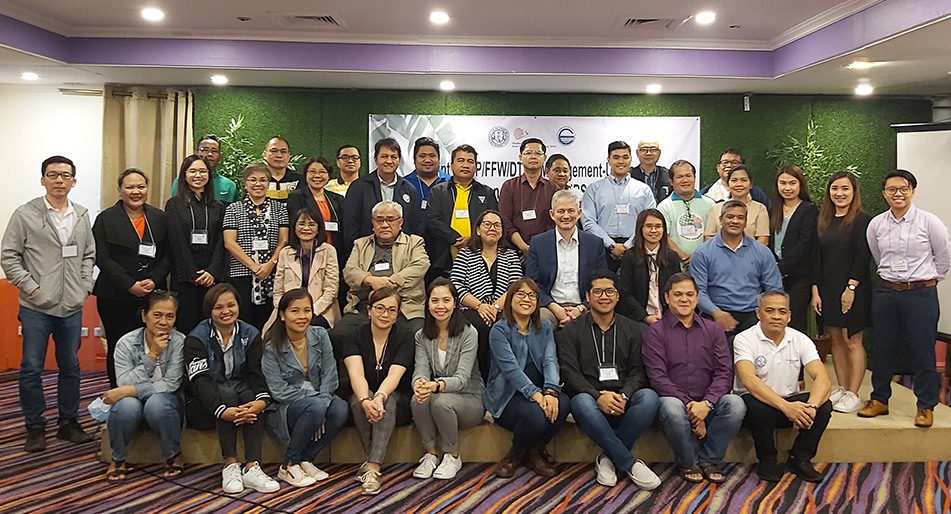
The Employers Confederation of the Philippines (ECOP) together with Federation of Free Workers and with the support of Danish Trade Union Development Agency (DTDA) conducted its first Luzon Symposium on Corporate Social Responsibility on the theme “Corporate Social Responsibility (CSR) as a Response to the Future of Work and the Challenges of New Globalization, Climate Change and the Fourth Industrial Revolution (Industry 4.0)” last 5-7 February 2020 at Bayview Park Hotel, Manila.
The symposium aimed to promote principles-based, inclusive and business sustainable corporate social responsibility (PBIBS-CSR) as a response to the future of work and the challenges of the new globalization, climate change and the so-called fourth industrial revolution (FIRE), a.k.a. Industry 4.0. Lastly, it sought to demonstrate social dialogue, tripartism, and bipartism, as mechanisms for shaping the responses to the challenges at enterprise, industry, sectoral and national levels.
Session topics that were discussed are 1) CSR Project Framework which is Principles-based, Inclusive and Business Sustainable CSR, 2) CSR and the International Instruments, 3) Social Dialogue: Definitions, Principles, Forms, Levels, Enabling Conditions, Benefits and Challenges, and 4) Risk Assessment using the PBIBS-CSR Risk Assessment Tool. Plenary presentations on “The Future of Work” and the “Impact of the Fourth Industrial Revolution (FIRE) on Employment” were discussed by International Labor Organization (ILO) and Philippine Institute for Development Studies, respectively.
The symposium concluded with a workshop session aimed at crafting a set of recommendations on how to commonly address the economic, social, and labor market challenges brought about by the new globalization, climate change and Industry 4.0.
Present during the symposium were management and union representatives of the CSR Project pilot enterprises (Continental Temic, Interphil Laboratories, Allied Metals, Delfi Foods, Globe Telecom) as well as companies coming from different industries such as hospitals, logistics, transportation, and food processing. Participation was also extended to selected officers of trade union federations, business organizations, and academe.