
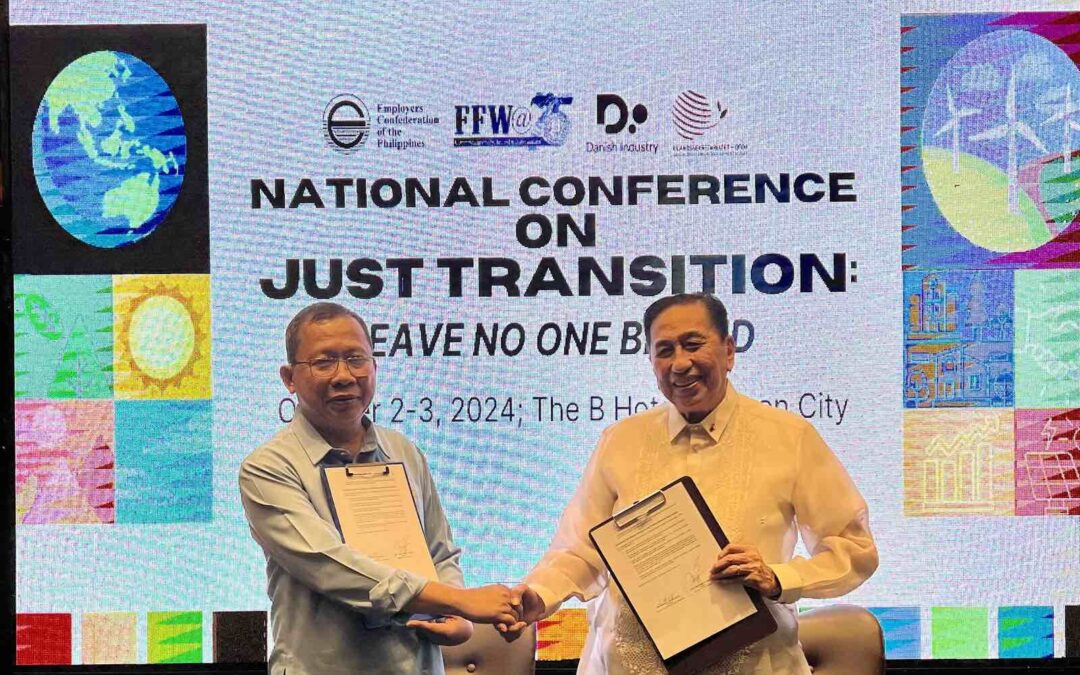
As climate disasters that pound on work and livelihoods persist and the shift to clean, renewable energy ever more pressing, employers and workers have come up with a landmark agreement that emphasizes that bipartism should be at the core of the country’s just transition framework.
The Employers Confederation of the Philippines (ECOP), the official umbrella organization of employers on labor and social policy issues; and the Federation of Free Workers (FFW), a national trade union center representing 100,000 workers signed today the Bipartite Declaration on Just Transition from a fossil-fuel driven to a low carbon economy that is sustainable and environmentally sound in front of some 100 employer and worker representatives.
“ECOP’s vision for a just transition is clear: through policy advocacy, bipartism, and our Sustainability Roadmap, we are paving the way for businesses to succeed in a green economy while ensuring that workers are supported every step of the way,”: said Sergio Ortiz-Luis, Jr., president of ECOP.
“There is no just transition without workers’ rights. We are glad that employers agree with workers on this point. We need a seat at the table,” said Atty. Sonny Matula, president of the FFW.
The Philippines is still defining its just transition framework, with the Department of Environment and Natural Resources (DENR) calling for a forum on the matter just a couple of days ago.
“A just transition is not just about meeting environmental goals; it is about balancing those goals with the economic realities businesses face,” added Ortiz-Luis.
“Aside from workers’ rights, the PH just transition work programme should include social inclusion, poverty reduction and coherence in addressing economic, social and environmental issues,” added Matula.
The Bipartite Declaration on Just Transition, the first of its kind in the Asia-Pacific Region, makes the following commitment:
1. Form a national bipartite just transition committee and encourage establishment of industry- and enterprise-level bipartite just transition committees;
2. Call for genuine representation of workers and employers in any and all just transition structures and/or mechanisms organized by government;
3. Explore areas for possible joint activities based on the Workers for Just Transition 13-Point Labor Agenda and ECOP’s Sustainability Roadmap;
4. Engage with the appropriate government agencies and institutions relating to national policies, laws and programs on Just Transition, the country’s NDCs under the Paris Agreement, greening of the PDP, the LEP, and the National Just Transition Work Program, creation of green jobs, the Trabaho Para sa Bayan Act, the CCC, and the country’s sustainability targets under the SDGs and AmbisyonNatin 2040; and
5. Promote and conduct awareness-raising activities, research, partnerships, capacity-building, training, and services on greening and just transition.
“It is not enough to simply advocate for change; we must also help businesses operationalize that change, turning policy into action that benefits both the economy and the environment,” added Ortiz-Luis.
“We plan to put forward our agreement and recommendations to appropriate government agencies, stakeholders and our own respective employer- and worker-members. We shall pursue relentless dialogue and action for sustainable development and decent work,” added Matula.
The bipartite declaration signing highlights the two-day National Conference on Just Transition jointly organized by the FFW and ECOP with the support of the Danish Trade Union Development Agency and Danish Industry, as part of a partnership agreement involving the workers’ and employers’ organization from the Philippines and Denmark.
Download a copy of Bipartite Declaration HERE